
Earlier this yr, Joshua Browder, CEO of AI startup DoNotPay, tried to carry a robotic lawyer right into a California courtroom, regardless of virtually definitely understanding that it was unlawful in virtually all 50 states to carry automated help like this right into a courtroom.
DoNotPay payments itself because the “world’s first robot lawyer” whose purpose is to “level the playing field and make legal information and self-help accessible to everyone.” It helps to serve society’s lower-income section to decrease medical payments, attraction financial institution charges, and dispute credit score studies. It claims to have helped greater than 160,000 folks efficiently contest parking tickets in London and New York.
It was denied entry to the California courthouse, nevertheless, as a result of “under current rules in every state except Utah, nobody except a bar-licensed lawyer is allowed to give any kind of legal help,” Gillian Hadfield, professor of regulation and director of the Schwartz Reisman Institute for Technology and Society on the University of Toronto, tells Magazine.
Still, within the age of ChatGPT and different gorgeous synthetic intelligence gadgets, Browder’s try might be a foretaste of the long run.
“The DoNotPay effort is a sign of what is to come,” Andrew Perlman, dean and professor of regulation at Suffolk University Law School, tells Magazine. “Certain legal services, including many routine legal matters, can and will be delivered through automated tools. In fact, it is already happening at the consumer level in numerous ways, such as via LegalZoom.”
Such assistance is urgently wanted within the view of many. In the U.S., low-income Americans “do not receive any or enough legal help for 92% of their civil legal problems,” in accordance to a Legal Services Corporation examine (2022). Almost half surveyed don’t search assist due to excessive authorized prices, and greater than half (53%) “doubt their ability to find a lawyer they could afford if they needed one,” in accordance with the LSC survey.
“This access-to-justice gap is a serious problem, and automated tools can be an important part of the solution,” feedback Perlman.
Can AI democratize authorized providers?
It could solely be a matter of time earlier than AI reaches the courtroom. If so, it might assist to wring human bias out of the authorized system. “In a legal setting, AI will usher in a new, fairer form of digital justice whereby human emotion, bias and error will become a thing of the past,” says British AI knowledgeable Terence Mauri, writer and founding father of the Hack Future Lab.
Will it advance the day when authorized providers are really democratized? “Absolutely,” says Hadfield. “This is the most exciting thing about AI now.” Not solely can it scale back the price of authorized providers within the company sector — “and I think that’s coming — “but the huge payoff will be in addressing the complete crisis we face in access to justice.”
But extra work should still be wanted earlier than AI turns into widespread within the courthouse. The regulation doesn’t have a lot tolerance for technical errors. The stakes are just too excessive. “I’ve used ChatGPT, and it often summarizes the law correctly. But sometimes, it makes mistakes,” John McGinnis, a regulation professor at Northwestern University informed USA Today. “And (that’s) not a surprise. It’ll get better. But at the moment, I think going into the courtroom was something of a bridge too far.”
Hadfield herself has been working in Utah and elsewhere to ascertain regimes for licensing suppliers apart from attorneys to supply some authorized providers. Consumer entry to authorized providers is important for the pursuits of equity and is more and more doable, given the speedy evolution of know-how. As Hadfield explains to Magazine:
“I don’t think a fully unregulated/unvetted DoNotPay should be out there, but there should be an easy way to license it against the standard: ‘Does this make the user better off than they are now?’”
Most folks partaking with the regulation right now — together with the folks DoNotPay is aiming to assist — “get zero legal assistance, so that bar may not be high,” provides Hadfield.
A world want
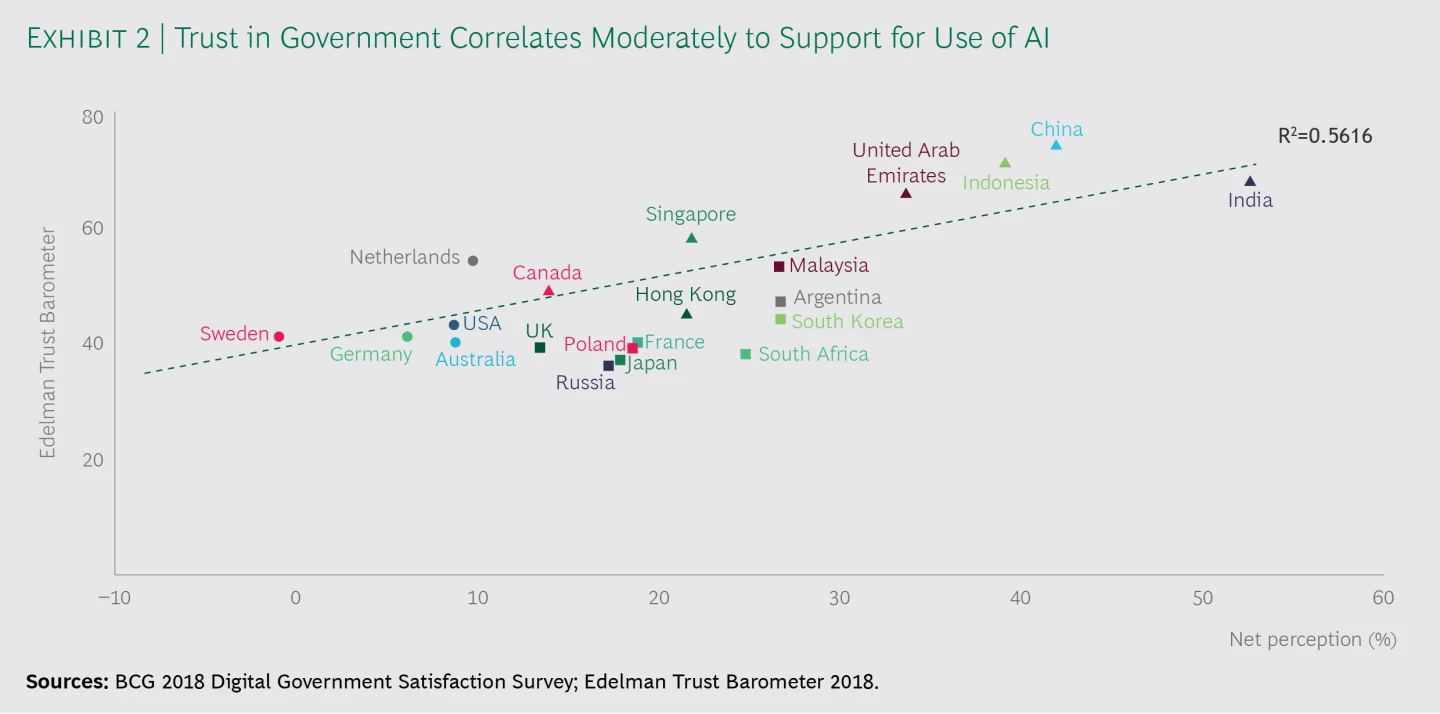
AI’s promise of delivering accessible, moderately priced authorized providers might quickly acquire traction past the United States, too. Indeed, AI-driven options could also be much more welcome within the growing world. A Boston Consulting Group examine on “The Use of AI in Government,” for instance, discovered that individuals in much less developed economies “where perceived levels of corruption are higher also tended to be more supportive of the use of AI.” Those surveyed in India, China and Indonesia indicated the strongest help for presidency functions of AI, whereas these in Switzerland, Estonia and Austria provided the weakest help.
“Basic services such as drafting wills or simple contracts, or challenging government decisions, should not require the services of a lawyer,” Simon Chesterman, a David Marshall professor and vice provost on the National University of Singapore, tells Magazine, acknowledging that “the emergence of chatbot lawyers offers some short-term gains in terms of access to justice.”
More refined authorized questions will proceed to require human attorneys and judges for the foreseeable future, nevertheless, Chesterman provides. Indeed, the BCG survey discovered that almost all of these surveyed globally “did not support AI for sensitive decisions associated with the justice system, such as parole board and sentencing recommendations.”
Read additionally
Features
Sell or hodl? How to arrange for the tip of the bull run, Part 2
Features
William Shatner Tokenizes his Favorite Memories on the WAX Blockchain
A job for blockchain?
Is there a spot for blockchain know-how with regards to bringing authorized providers to the under-served — maybe working in tandem with synthetic intelligence? Some assume so. A authorized system is constructed on a basis of belief. People should consider that selections are made in accordance with ideas of equity. This is the place black-box AI options like ChatGPT can come up quick. One can’t simply see how selections are being made.
Public blockchains, against this, are famously clear. They present a transparent, tamper-free ledger of transactions or interactions from a undertaking’s starting. “It is evident that the deployment of digital technologies, such as blockchain, is key to the development of AI,” writes Antonio Merchán Murillo, a professor at Spain’s Pablo Olavide University.
Blockchain’s strengths — transparency, traceability, decentralization and authentication — can complement AI, whose opaque algorithms can typically confound. “Blockchain has the mission of generating trust, transparency, and acting as a mediator,” explains Murillo, and it may well allow AI initiatives “to act and connect with each other” in addition to present “valuable information about origin and history.”
Smart contracts particularly might play a job in an evolving authorized system. “In the near future, many commercial contracts will be written as smart contracts,” Joseph Raczynski, a futurist and know-how advisor, tells Magazine. Both applied sciences might be transformative for the regulation, he says:
“Unquestionably, the legal industry is primed to be significantly impacted by both AI and blockchain in the not-too-distant future.”
Smart contracts are actually simply snippets of laptop code, nevertheless, so it bears asking: Are they enforceable? Perhaps. It relies on the jurisdiction. In the U.S., “smart contracts are a type of contract, and therefore they’re enforced like all contracts in state and federal court systems,” legal professional Isaac Marcushamer informed LegalZoom. One disadvantage is that sensible contracts can’t simply be modified, and at current, they’re used primarily for easy transactions. As the know-how evolves, nevertheless, many assume they’ll carry out extra complicated duties.
Recent years have seen a proliferation of decentralized justice methods. Prominent amongst them is Kleros, “a decentralized blockchain-based arbitration solution that relies on smart contracts and crowdsourced jurors,” in accordance to a current regulation journal article. Kleros is principally utilized in enterprise contract disputes — e.g., “car insurer did not pay for the repair” or “the airline did not reimburse the canceled flight.” When a dispute arises, “Kleros selects a panel of jurors and sends back a decision.” According to Kleros’ white paper, it depends on “game theoretic incentives to have jurors rule cases correctly.”
Importantly, Kleros doesn’t cost person charges. It makes cash not directly by the appreciation of its PNK tokens which might be wanted to entry the platform. In this manner, its “decentralized sheriff contributes to the public good by filling a regulatory hole with respect to the crypto market,” in accordance with the regulation journal article. The platform faces main obstacles earlier than it may well go mainstream, nevertheless, amongst them discovering regulatory acceptance, the authors add.
A risk-averse business
Overall, authorized methods is not going to be disrupted instantly. “Despite the fact that AI has hit an inflection point recently, it’s unlikely that we will see AI assistance directly interacting in the next year,” predicts Raczynski. “However, in the next two or three years, I think it is highly possible select jurisdictions will test it.”
The purpose is that attorneys and the authorized business usually are usually “extraordinarily risk averse,” Raczynski provides. “The idea that AI will act as a lawyer in the courtroom imminently is doubtful.”
Michael Livermore, a professor on the University of Virginia’s School of Law, acknowledged final yr {that a} computer-written authorized opinion is at the least 10 years away. Asked if more moderen advances in pure language processing (NLP) and different types of AI had modified his timetable, Livermore tells Magazine:
“There is no doubt that current NLP is quite impressive, and it’s easy to foresee a tool coming online soon that could write a pseudo-legal opinion — i.e., a document that’s written in the style of a legal opinion. But writing a convincing and sustained argument, that is grounded in a reasonable interpretation of existing law — I think we’ll still have to wait a few years for that.”
It is difficult to foretell how “the involvement of robot lawyers may shape the dynamics of trial hearings and other judicial proceedings,” Zhiyu Li, an assistant professor in regulation and coverage at Durham University, tells Magazine, “for example, whether and how litigants can communicate with their robot lawyers during the trial.”
Also, what if robotic attorneys are immediately sidelined by technical difficulties? More procedural guidelines could also be wanted to make sure the rights of litigants assisted by machines throughout proceedings, says Li. “For the time being, I have reservations about AI’s readiness to function like a human lawyer in trials,” she provides.
“Lives are at stake”
Another concern: Do the builders of authorized bots have enough information and expertise of the regulation? Is the information that they’re utilizing to “train” their algorithms related and updated? Will they inadvertently omit information that “could cause key evidence or elements to be filtered out or overlooked by a robot judge or AI software?” asks Li. “The decision-making of criminal cases deserves so much attention because oftentimes criminal defendants’ freedom and even their lives are at stake.”
Others draw a line between attorneys utilizing AI to conduct analysis and robo-judges rendering selections in felony instances. Replacing human judges entails a severe elevating of the AI ante.
“There is something critical about being judged by another human,” says Hadfield. “On the other hand, vast numbers of people [already] get no or very little human judgement in their cases — think small claims courts where 50 cases can be decided in a day.”
Human judges supported by know-how might characterize a wise center floor. AI algorithms might be used to make sure bias (racial, gender, age, and so forth.) isn’t occurring. This might “reassure everyone that they are getting fair, neutral, accurate and unbiased judgement,” says Hadfield.
Using AI to strategize
AI will play a major position within the preparation work that litigators have interaction in behind the scenes right now “in their research and, increasingly, strategy,” says Raczynski. “Legal outcomes can now be empirically weighed via prediction models using similar, previously litigated cases, and their docket information by judge and jurisdiction.” Judges exhibit patterns that may be revealed by machine studying algorithms, and attorneys could more and more use AI to discern these patterns.
Does all this portend an upending of the world’s authorized methods? Are attorneys an endangered species?
“As basic legal services are outsourced to machines, the demand for junior lawyers will diminish,” mentioned Chesterman. “That raises the question of how we will find the next generation of senior lawyers if they can’t cut their teeth as juniors.” Moreover, in lots of jurisdictions, that is resulting in a broadening of the scope of labor for attorneys — in addition to the emergence of allied authorized professionals — to help the business, he provides.
AI search, workflow and automation instruments mixed with NLP and pure language technology fashions “will vastly reduce the need for routine lawyerly work,” says Raczynski, whereas in litigation, “it is conceivable that a Kleros — decentralized alternative dispute resolution system — could be a model to resolve conflict rather than leveraging the courts.”
“I think we are about to see major disruption in our legal systems,” provides Hadfield.
Still, “even with significant automation, lawyers will play an essential role in society and the delivery of legal services,” predicts Perlman. “AI does not mean the end of lawyers, but it might mean the end of legal services as we know it.”
“Large law firms will survive by handling highly complex issues,” says Raczynski. Small and medium-sized companies could not fare so nicely. “Across the industry, it’s the cookie-cutter work that most firms do now that will implode.”
Subscribe
The most partaking reads in blockchain. Delivered as soon as a
week.

AI for capital instances
But certainly not all authorized selections may be entrusted to algorithms? What about capital instances the place a person is charged with first-degree homicide? Can one actually depend upon an algorithm when a human life is on the road?
“In the early phases of any technology, especially in the legal industry, mistakes are not acceptable,” Raczynski tells Magazine. Still, “I firmly believe, in 15–20 years, we will trust algorithms to adjudicate the most complex legal cases.” At that point, many extra contracts will depend on code and more and more grow to be extra common. Code might be extra reliable, outlined and clear.
The digital database of authorized instances that allow algorithms to “learn” may also be huge, Raczynski provides. “At the very least, these algorithms will be a sort of augmented intelligence for judges to help them make a decision.”
Thus, the authorized neighborhood will most likely start by making use of AI to much less vital use instances, akin to contesting parking tickets. More consequential AI-aided instances will come later, most likely after some type of monitor document has been established.
And all this nonetheless doesn’t imply that each one authorized providers ought to be delivered in an automatic manner, both — as with the aforementioned capital instances. “We will need to harness these new tools in ways that give the public greater access to legal services while ensuring appropriate protections for the legal system and society,” says Perlman.
One may also want to recollect “that law is a social and political process, not just a set of fancy calculations,” provides Livermore.
Are blockchain-based authorized agreements coming?
Smart contracts hosted on blockchains would possibly sooner or later streamline conventional attorneys’ work product, lowering billing hours. Futurist Joseph Raczynski illustrates for Magazine how a sensible contract with its conditional — i.e., if/then — statements can be utilized to create a belief for property planning.
This (fictitious) belief stipulates the switch of an property’s belongings upon sure circumstances: First, each dad and mom should be lifeless. Second, the 2 kids — the beneficiaries — should be married to ensure that them to separate the property equally. “If one child is married and the other is not, the child that is married gets the entire estate,” Raczynski explains.
The belief is written as a sensible contract saved on a blockchain with code that identifies parameters which might be contingencies or probably topic to alter. “Saved as a smart contract on a blockchain, it is now in an immutable state but has actionable items embedded in it. The only people that have access to this document are the attorney that drew it up and her client.”

The sensible contract is checked frequently by a trusted supply — i.e., an “oracle” — to find out if each dad and mom are nonetheless alive, explains Raczynski. “One day, the computer identifies that the parents have passed.” It now has to find out the marital standing of each kids:
“Through another API computer call to that oracle, it finds out that one child is married, and the other child is not, and subsequently sends 100% of the liquid assets to the kid that is married – into their digital wallet,” continues Raczynski. “This is a self-executing smart contract on a blockchain where, in the future state, no human (lawyer) intervention is needed.”
The significance of oracles
It ought to be famous that the effectiveness of the above situation assumes the provision and accuracy of blockchain “oracles” to find out the “aliveness” of the dad and mom and the “marital status” of the kids. This might be problematic in the true world. Not all deaths could also be recorded electronically in some jurisdictions. Fragmentation might be an issue. In the U.S., for instance, the 50 states handle their very own demise registration methods.
In different phrases, on this situation, as in so many others, one could have to attend for real-life blockchain oracles to “catch up” earlier than blockchain-based authorized agreements may be totally realized.
Read additionally
Features
Before NFTs: Surging curiosity in pre-CryptoPunk collectibles
Features
The Road to Bitcoin Adoption is Paved with Whole Numbers

Content Source: cointelegraph.com