

Opinion by Paul Brody, founder and chief government, Nightfall Networks
Do you keep in mind Pets.com? It raised $110 million from Amazon and others to construct a enterprise the place folks ordered pet toys and pet food on-line.
The firm crashed and burned, and everybody discovered an vital lesson: you may’t profitably ship a 50-pound bag of pet food to a buyer’s door.
As on-line retail entrepreneur Ed Baum requested in a 2001 postmortem: “Did Pets.com’s business plan assume the invention of transporters to magically move bags of pet food without shipping costs?”
Please, no matter you do, don’t share this with the folks at Chewy; they may not understand their enterprise mannequin doesn’t work. Chewy reported $12.6 billion in gross sales and $223 million in internet earnings in its newest fiscal 12 months.
The actual lesson of Pets.com wasn’t that transport pet food was a foul thought. It’s that the concept arrived earlier than the logistics, buyer habits and unit economics required to make it work.
As it was with chew toys and pet food, so it might be with enterprise blockchains.
Collectively, the crypto business in all probability incinerated simply as a lot cash making an attempt that between 2017 and 2023 as Pets.com. Maybe extra. But the handfuls of firms that went after enterprise blockchain weren’t delusional; they had been simply too early.
Why companies want enterprise blockchains
It’s not exhausting to grasp the enchantment of enterprise blockchain options, at the very least superficially. Nearly all enterprise programs at the moment are inclined to fail on the boundaries between firms. There are two failure modes: mode 1, the OG failure mode, the place collaboration info is continually out of sync.
In this world, enterprise IT programs are islands, speaking asynchronously with one another by digital textual content messages and emailed spreadsheets. It’s low-cost and straightforward to arrange, if you happen to don’t thoughts at all times having barely unsuitable info.
Related: Privacy is lacking ingredient for enterprise blockchain adoption: EY exec
Failure mode two is the pricey, real-time proprietary integration. Powerful business leaders politely request their key suppliers and companions to affix their closed however always-on networks.
Chewy reported $223 million in internet earnings in its newest fiscal 12 months. Source: Chewy.
These are very pricey, however they work nicely and go away everybody with a type of enterprise model of Stockholm syndrome, the place you come to understand the thoroughness and effectivity of the digital choke-hold you might be in.
Blockchains provided a greater path ahead: shared info and enterprise logic throughout an open ecosystem. All the advantages of a proprietary system when it comes to real-time visibility and effectivity, with out the lock-in.
Sometime round 2017, this began to appear like a really apparent good thought. Investment poured in, consortia launched, press releases had been drafted and launched, after which just about every little thing crashed and burned. TradeLens, We.Trade, Contour, B3i, ASX Chess, Everledger. All got here and went in just some years.
Though there may be lots of nuance to the main points of every of those tales, all of them largely have one factor in widespread: they needed to do unnatural issues to make up for the shortage of privateness obtainable natively in blockchains.
Companies want privateness, not transparency
No firm needs their competitors to see what they’re doing intimately. Mostly, this meant constructing a personal/permissioned chain after which doing numerous non-blockchain-like issues to it and in it to attempt to hold info non-public. The outcomes had been uniformly sluggish and costly and failed to achieve traction.
It’s exhausting to understate the massacre of firms and startups that attempted and did not make enterprise blockchain work. A fast net and historical past search turned up 18 completely different ones, a few of them well-known.
Many had big-name backers, from main banks like Deutsche Bank and HSBC to know-how firms like IBM. Pedigreed mother and father and large manufacturers made no distinction — privateness didn’t work and the outcomes had been dismal.
What few survivors of this are left have “de-chained” themselves — giving up the blockchain theater and reverting to a traditional software-as-a-service (SaaS) mannequin. Many firms that attempted and examined these permissioned enterprise programs as customers got here away from their expertise with a transparent studying: we tried blockchain, it didn’t work.
That’s unlucky as a result of every little thing is completely different now.
Blockchains at the moment have scalability, privateness and liquidity
Blockchains have scale. Ethereum in 2020 dealt with 1 million transactions a day and prices per transaction periodically spiked to $30-50 when demand was excessive. Today, most transactions get executed beneath a penny and capability is ramping towards billions of transactions a day. Nobody talks concerning the “trilemma” anymore. Ethereum is decentralized and it’s scaled.
Related: Ethereum’s Glamsterdam improve launches on Sepolia testnet
Privacy is completely different now, too. While privateness continues to be not the default setting, an enormous vary of privateness instruments and programs at the moment are obtainable, from privateness swimming pools to zero-knowledge roll-ups and full privateness chains.
On prime of that, Ethereum is constructing a variety of instruments that can add fundamental components of privateness at a number of ranges within the community. The end result: it’s now doable to run enterprise operations at scale with a excessive diploma of privateness.
Finally, there’s the cash. It’s all transferring onchain. Regulators across the globe have blessed stablecoins and the result’s a tsunami of liquidity, with transaction quantity reaching virtually $1.8 trillion in June.
If we mix the operational advantages of blockchains with the monetary ones, we get one thing that enterprises have by no means actually had earlier than: a single ecosystem the place you cannot solely purchase, promote, and transfer property, however receives a commission for them as nicely.
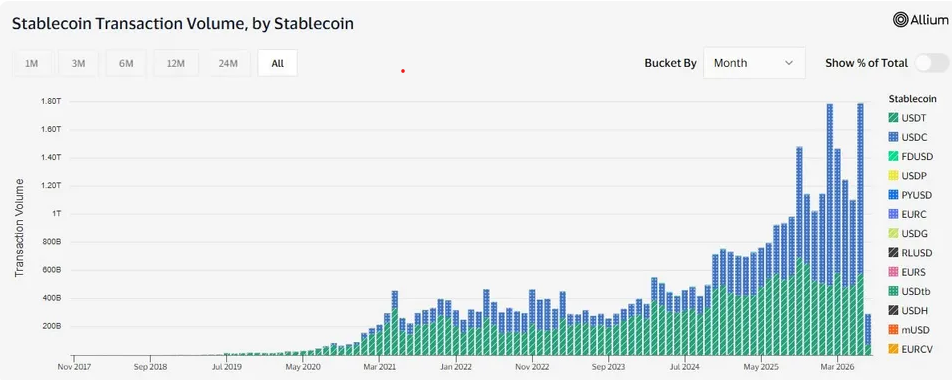
There was just below $1.8 trillion in adjusted stablecoin transaction quantity in June. Source: Visa
The return on funding from each single part of this equation is huge. Combined, they’ll yield colossal benefits. McKinsey companions even discovered that digital provide chain instruments may make stock reductions of 35-75% doable by way of higher planning.
More conservatively, from my expertise within the subject, simply switching away from the prevailing cascades of spreadsheets and digital knowledge interchange (EDI) messages can enable corporations to run most provide chains with about 20% much less stock on the identical service stage. That’s price billions in working capital in most industries.
It will get higher from there. Smart contracts scale back the time required to deal with many enterprise contract guidelines from days to minutes and minimize the prices of administration in half.
Microsoft started transferring its Xbox online game community onto good contracts for dealing with royalties and minimize the time to entry month-to-month royalty statements from 45 days to 4 minutes. All that whereas dealing with greater than 2 million transactions a day.
And upon getting inventories, contracts, buy orders and invoices onchain, you may go after working capital instantly as nicely.
When you may show your buy order originates from a top-quality purchaser, you may entry credit score for much less. And when you could have full visibility into stock and supply standing, you may issue receivables instantly and effectively.
The potentialities and the returns are huge. The use circumstances are apparent. It’s time to strive once more.
Magazine: What Democrats’ US midterm sweep means for the CLARITY Act
About the creator: Paul Brody is the Founder and CEO of Nightfall Networks, a blockchain know-how firm targeted on constructing sturdy privateness programs for enterprise customers. He is the previous Global Blockchain Leader at EY and the previous Chairman of the Enterprise Ethereum Alliance.
Content Source: cointelegraph.com