

Opinion by Michael Egorov, founding father of Curve Finance and Yield Basis
For a very long time, the apparent approach to consider onchain international change (FX) was to start out on the high. Banks tokenize currencies, giant monetary establishments transfer their FX exercise onchain and institutional liquidity naturally follows.
The finish outcome? Blockchain-based FX finally grows giant sufficient to resemble its conventional counterpart. But that’s not essentially how it’s going to occur.
In truth, there are rising indicators that onchain FX will develop within the precise reverse approach — from the underside up.
Stablecoins like Brazilian Digital (BRZ) or Monerium’s EURe could be rapidly redeemed onchain and simply moved from digital wallets to financial institution accounts. They generate wholesome buying and selling exercise as decentralized finance (DeFi) customers swap them in decentralized change (DEX) swimming pools.
Markets like this find yourself growing in actual time round a sensible consumer want, which is transferring instantly between digital currencies and fiat.
This remains to be simply an early-stage instance, however the use case and demand are actual sufficient. Keyrock information reveals that almost all of onchain stablecoin trades tied to rising market currencies fall within the $1,000 to $10,000 vary — modest quantities in comparison with institutional scale — however that’s exactly the purpose.
It reveals how the market is constructing within the basic route of onchain FX to satisfy sensible fee wants, not simply giant merchants.
‘Small’ isn’t the identical as ‘useless’
People and companies want to maneuver their cash between currencies, and clearly, they don’t seem to be content material to attend for main conventional finance (TradFi) establishments to maneuver their FX operations onto blockchain rails.
Related: Paraguay financial institution collapse reveals stablecoins can supply a lifeline… of kinds
There’s a reasonably widespread assumption about onchain FX in {that a} market wants big liquidity earlier than it may possibly turn into actually helpful. In observe, although, that’s not fully true.
If there may be real demand from somebody who must change {dollars} into euros, Swiss francs or one other foreign money, even a smaller pool can course of these transactions and serve an actual financial function.
Stablecoin DEX Trade Volume. Source: Keyrock Research
Onchain FX doesn’t must turn into massive earlier than it turns into helpful; as a substitute, it may possibly develop exactly as a result of individuals are truly utilizing it.
As a matter of truth, this is kind of what occurred with stablecoins. They started as a comparatively area of interest crypto-native use case, and but right now we already know them to be a part of a wider monetary infrastructure.
Chainalysis just lately shared information that reveals cross-border stablecoin exercise jumped to over $220 billion by mid-2026. That’s an virtually 80% development over the course of 1 12 months, proving that demand and exercise are consistently on the rise. There is not any cause onchain FX can’t comply with an identical path.
The consumer doesn’t care how massive the market is
This is definitely essentially the most sensible aspect of this situation. Onchain FX clearly received’t have the ability to compete with your complete international international change market anytime quickly; that’s nonetheless years away. But the extra fascinating query is what issues it may possibly clear up for somebody who already has cash onchain.
Today, you’ll be able to change a USD stablecoin right into a EUR stablecoin (or another different) onchain and use that cash for funds with comparatively little bother. In truth, doing it this manner is commonly quicker and cheaper than going with a traditional worldwide financial institution switch.
Related: Circle’s ARC token sale lifts earnings as decrease yields weigh on USDC revenue
The similar logic applies to onchain FX. A fintech or crypto-card firm doesn’t must recreate your complete institutional market; what they want is to maneuver their prospects’ funds effectively between currencies.
When somebody is making an attempt to pay in a unique foreign money, changing it may possibly add prices to the operation, because it normally entails Visa or Mastercard, which cost round 1% in processing charges.
Onchain exchanges are a a lot better possibility right here. If consumer funds are already dwelling on blockchain rails, swapping USD stablecoins into EUR stablecoins could be finished instantly, with out going via any further intermediaries, which is each quicker and more cost effective.
Banks will most certainly stay essential entry and exit factors the place digital cash must work together with the actual world. Issuing and redeeming native currencies, accessing financial institution accounts, coping with compliance and such is the place banks will take the lead.
But when the cash is definitely onchain, most of the conventional “in-between” steps could be dropped for better effectivity.
From the angle of a consumer who simply desires to conduct a monetary switch with minimal issues, that’s a extremely optimistic enchancment. How massive or small the general market issues little on this case.
Demand is barely half the issue
There is, in fact, a catch.
Real demand is essential, however it doesn’t magically clear up the issue of liquidity. The problem isn’t merely to create a EUR/USD or CHF/USD pool; it’s to make them economically sustainable.
This is the place automated market makers could make a distinction. Traditional market-making corporations might not discover it engaging to offer liquidity for a small FX market; there might merely not be sufficient quantity to justify the operational prices.
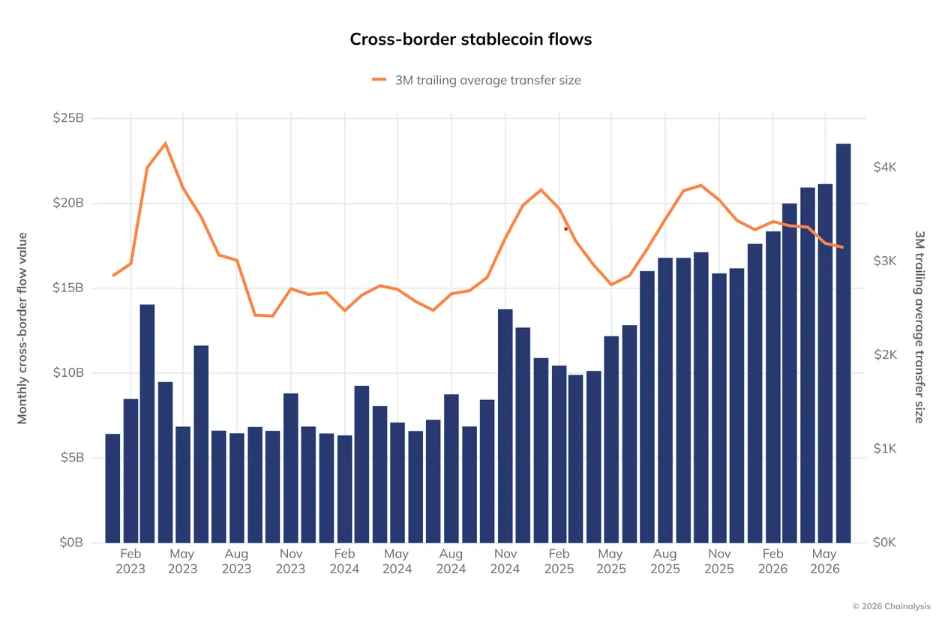
Cross-border stablecoin flows. Source: Chainalysys
Automated liquidity adjustments that equation as a result of software program can present liquidity constantly with out requiring a market-making agency to manually handle each commerce.
Imagine two greenback stablecoins, USDC (USDC) and Tether (USDT). From the angle of a conventional change, transferring from one greenback stablecoin into one other would possibly appear to be a reasonably boring enterprise. Both property are imagined to be value roughly $1, so there isn’t a lot value motion to commerce round.
But if there may be nonetheless an actual want for folks to modify between stablecoins like that, an automatic market maker can create a pool the place customers could make that swap instantly. Each commerce generates a small payment for the liquidity suppliers, and when sufficient folks want the identical conversion, a market can exist even when it doesn’t look significantly thrilling to a conventional market maker.
This form of adoption can not precisely be known as explosive, true, however there’s additionally nothing fallacious with sluggish, pure development. Sometimes, new markets simply want a small group of people that have an issue the prevailing infrastructure doesn’t clear up significantly properly. If these customers could make the market economically viable, liquidity can develop from there.
About the creator: Michael Egorov is the founding father of Curve Finance and Yield Basis. He can be a physicist, entrepreneur and crypto maximalist. Michael transitioned from the scientific subject to the crypto trade and holds a bronze medal from the International Physics Olympiad and a PhD in ultracold atoms.
Magazine: Can decentralized telephone networks energy the AI revolution?
Content Source: cointelegraph.com