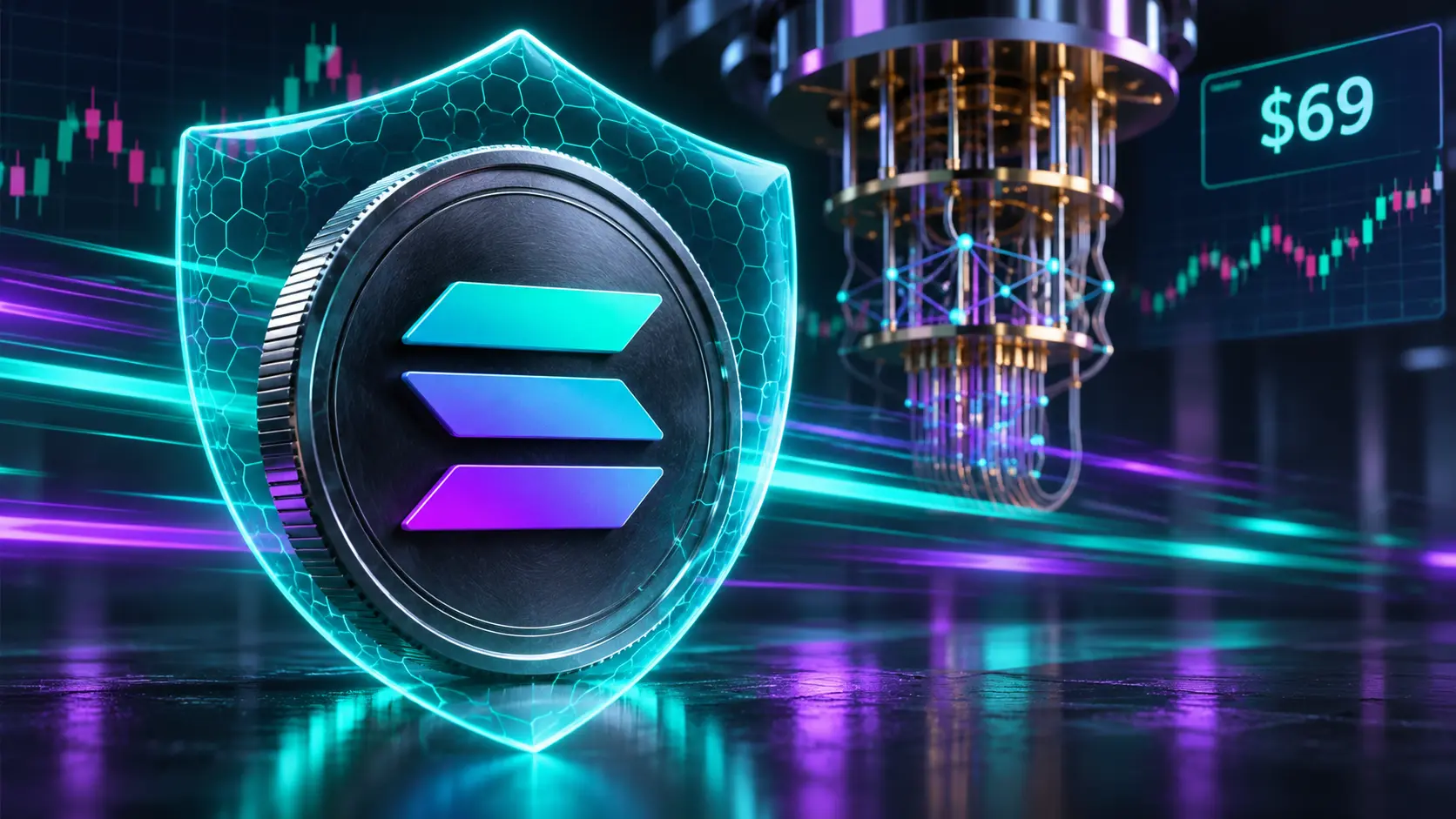
The SOL worth is having a tough month. But behind the chart, Solana’s builders are engaged on an issue most blockchains haven’t began to deal with but: the best way to survive the arrival of highly effective quantum computer systems with out dropping the velocity that made the community well-known.
SOL trades close to $69, caught in the identical sell-off that dragged Bitcoin to its lowest stage in two years this week. Yet the community’s long-term Solana quantum roadmap is quietly taking form.
It has three shifting elements: new signatures for customers, a redesigned consensus system for validators, and a technique to safely transfer current wallets.
None of it’s reside but. But the groundwork is additional alongside than many traders notice.
Why Quantum Computers Are A Long-Term Risk
Today, Solana makes use of a signature scheme known as Ed25519 to show who owns an account and who can transfer funds. Like most blockchains, it depends on elliptic-curve math.
A strong sufficient quantum laptop operating Shor’s algorithm may, in concept, break that math. An attacker may work out a personal key from public info and forge signatures to maneuver cash they don’t personal.
That machine doesn’t exist but, and nobody can say when it’ll. But upgrading a reside community takes years, so preparation wants to start out early. The US National Institute of Standards and Technology made that time when it launched its first post-quantum requirements in 2024.
“We encourage system administrators to start integrating them into their systems immediately, because full integration will take time,” stated Dustin Moody, who leads NIST’s post-quantum standardization undertaking.
Falcon: The Compact Signature Solana Picked
Solana’s reply for consumer accounts is Falcon. Two of the community’s essential shopper groups, Anza and Jump Crypto’s Firedancer, studied the issue individually and reached the identical conclusion: Solana wants a post-quantum signature scheme with compact signatures constructed for high-throughput blockchains.
Both groups have already constructed preliminary Falcon implementations. The Solana Foundation stated in April that “network performance is not expected to see a meaningful impact” as soon as a migration is activated.
Size is the explanation Falcon received. A present Ed25519 signature takes up simply 64 bytes. Falcon-512 wants 666 bytes, whereas the choice ML-DSA normal wants 2,420 bytes, in response to Jump Crypto’s migration evaluation. On a community processing 1000’s of transactions per second, each further byte provides bandwidth prices.
Falcon continues to be roughly ten instances bigger than at present’s signatures, however it’s the smallest choice among the many post-quantum signature schemes NIST has chosen. Jump additionally famous that verifying Falcon signatures is comparatively easy, whereas the extra advanced signing work occurs off-chain in wallets.
What would Solana’s consensus appear like in a post-quantum world?
Meet Quantumglow: a proposed adaptation of Alpenglow that goals to guard consensus whereas preserving quick finality.
@jacobvcreech and @qkniep clarify the way it works. Full video beneath👇 https://t.co/G005a4KcSI
— Solana Developers (@solana_devs) October 22, 2026
Quantumglow Aims To Keep Finality Under A Second
User signatures are solely half the issue. Validators additionally use cryptography to vote on blocks and agree on the state of the ledger.
In October, Solana switched on Alpenglow, a brand new consensus system concentrating on finality of round 150 milliseconds, down from roughly 12.8 seconds earlier than. Alpenglow depends on compact signatures that bundle many validator votes collectively, and no equally environment friendly post-quantum model exists.
That is the place Quantumglow is available in. Anza researchers Quentin Kniep, Kobi Sliwinski and Roger Wattenhofer launched the design in July, saying it “features a similar state-of-the-art performance as Alpenglow, despite a radical shift in cryptographic primitives.”
Instead of compressing a big post-quantum signature into each message, Quantumglow removes signatures wherever attainable. It makes use of a customized hash-based scheme known as Ax and solely sends a big signature alongside small quantities of information.
It is essential to separate the 2. Alpenglow is reside. Quantumglow continues to be analysis with no deployment date.
A Safe Exit For Existing Wallets
The closing piece is defending cash that already sit in at present’s wallets. A consumer wants a technique to show possession {that a} quantum attacker couldn’t copy.
Anza has constructed a prototype that does precisely that. It lets a holder show they know the seed materials behind an current account and hyperlink it to a brand new post-quantum key. Because breaking a signature doesn’t reveal the unique seed, an attacker wouldn’t be capable to faux the migration.
The prototype proof continues to be giant, at roughly 400 kilobytes, so extra engineering is required. But migration is a one-time step, not one thing customers would pay for on each switch.
The Solana Foundation’s roadmap lays out the order clearly: hold researching Falcon and its alternate options, undertake a post-quantum scheme for brand new wallets if quantum turns into a reputable risk, after which migrate current wallets.
Why It Matters For SOL Holders
Quantum threat is commonly cited as one in all crypto’s largest long-term threats. A community that may present a examined path to post-quantum safety, with out sacrificing efficiency, has a powerful argument for establishments planning to carry belongings for many years.
Solana ain’t ready round for Q-Day.
Right after transport Alpenglow (~150ms finality), Solana devs dropped Quantumglow: a analysis design swapping in hash-based signatures for validators, protecting the chain quantum-resistant with out killing that velocity.
Future quantum computer systems may crack normal crypto and faux validator votes. The catch? Quantum-proof signatures are often heavy and homicide community throughput.
Quantumglow works round that bloat. It’s nonetheless in analysis and solely covers validators for now (wallets come later), however hardening the consensus layer earlier than the risk arrives is the transfer.
— Lark Davis (@LarkDavis) October 25, 2026
That form of elementary progress has stored constructing at the same time as the worth falls. Earlier this 12 months, community exercise stored rising at the same time as SOL slid beneath $80, and institutional urge for food was robust sufficient to push Solana ETF inflows above $1.16 billion.
Solana Price Levels To Watch
SOL’s 24-hour vary has stretched from about $65 to $71.60. The first goal for bulls is reclaiming that $71.60 excessive, adopted by the $75 stage the token misplaced final week.
Above that, the $80 zone is the important thing resistance that may sign an actual development change.
On the draw back, $65 is the primary assist to look at. A break beneath it could put the psychological $60 mark in play.
For now, macro stress from falling tech shares and a possible Fed charge hike is driving the worth. But Solana quantum readiness is the form of long-term work that tends to matter as soon as the market seems to be previous the panic. For extra updates, comply with the newest altcoin news.
What do you suppose?
Will Solana’s quantum readiness develop into a serious promoting level for establishments, or is quantum threat nonetheless too distant to maneuver the SOL worth?

Editorial Process for bitcoinist is centered on delivering completely researched, correct, and unbiased content material. We uphold strict sourcing requirements, and every web page undergoes diligent evaluate by our staff of prime expertise specialists and seasoned editors. This course of ensures the integrity, relevance, and worth of our content material for our readers.
Content Source: bitcoinist.com